
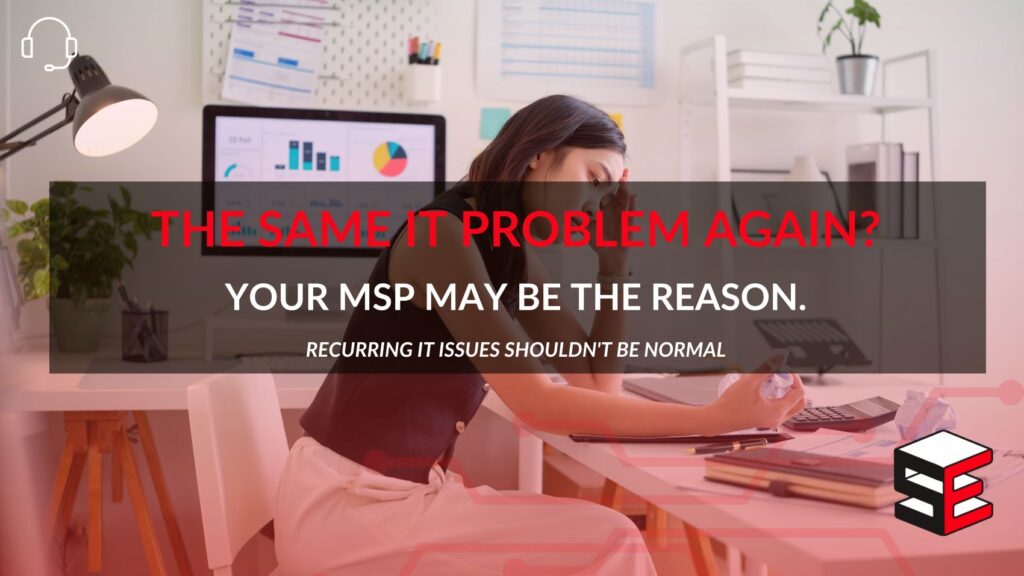
If you’ve worked with an IT provider for any length of time, you’ve probably heard some version of the following:
“That’s a Microsoft issue.”
“Technology isn’t perfect.”
“That’s just how the software works.”
“We’ll keep an eye on it.”
While there are certainly situations outside an MSP’s control, recurring technology problems should never become the norm.
The real question business leaders need to ask is simple:
Is your MSP actually solving problems, or are they making excuses for why those problems continue to happen?
The Difference Between Fixing Symptoms and Solving Problems
Many IT providers are excellent at responding to support tickets.
A user reports an issue.
A technician fixes it.
The ticket gets closed.
But what happens when the same issue returns next week? Or next month?
Closing tickets and solving problems are not the same thing.
A proactive Managed Service Provider should look beyond the immediate issue and identify the root cause. Otherwise, businesses become trapped in a cycle of recurring disruptions, frustrated employees, and lost productivity.
Common Signs Your MSP May Be Making Excuses
The Same Issues Keep Happening
Do employees regularly complain about:
- Slow computers
- Wi-Fi problems
- VPN connectivity issues
- Email delays
- Frequent password lockouts
- Application crashes
If these issues continue month after month, it’s worth asking why they haven’t been permanently addressed.
Every Problem Is Someone Else’s Fault
Technology vendors sometimes create challenges, but a good MSP acts as your advocate.
If every issue is blamed on Microsoft, your internet provider, a software vendor, or aging equipment without a clear plan to resolve it, accountability may be missing.
You Rarely Receive Recommendations
Your MSP should be providing strategic guidance.
That includes:
- Infrastructure improvements
- Cybersecurity enhancements
- Hardware replacement planning
- Process improvements
- Risk reduction strategies
If your provider only contacts you when something breaks, they may be operating reactively rather than proactively.
The Hidden Cost of Recurring IT Problems
Many businesses underestimate how much recurring technology issues cost.
A ten-minute disruption may seem minor.
Multiply that across dozens of employees, multiple occurrences per week, and an entire year, and the financial impact becomes significant.
Recurring issues create:
- Lost productivity
- Employee frustration
- Reduced client service levels
- Increased security risks
- Leadership distractions
Technology should help your business operate efficiently, not create daily obstacles.
What a Proactive MSP Does Differently
A strategic MSP focuses on prevention, not just response.
They ask questions such as:
- Why is this happening?
- Is there a larger infrastructure issue?
- Are aging systems contributing to the problem?
- Can automation reduce support requests?
- Is a project needed to eliminate future disruptions?
Their goal is to reduce recurring issues over time, creating a more stable and secure environment for your team.
Questions to Ask Your Current MSP
If you’re unsure whether your provider is truly proactive, ask:
- What recurring issues do you see in our environment?
- What are the root causes?
- What recommendations have been made to address them?
- Has our ticket volume increased or decreased over the past year?
- What proactive improvements have been implemented recently?
The answers may reveal whether your MSP is solving problems or simply managing them.
Final Thoughts
Technology problems happen.
But recurring technology problems that never seem to get resolved are often a sign of a reactive IT strategy.
Your business deserves more than temporary fixes and explanations.
It deserves a technology partner that identifies root causes, reduces recurring issues, and helps your organization operate more efficiently.
At Straight Edge Technology, we help businesses across Corpus Christi, San Antonio, and the Dallas-Fort Worth area move beyond reactive IT support with proactive technology management, cybersecurity protection, and strategic planning designed to keep operations running smoothly.